Sift Get the app
Introduction
Your first customers can mislead your growth
Early customers love your product, yet the wider market keeps postponing its purchase. Geoffrey Moore identifies the dangerous gap hidden inside that pattern, and the uncomfortable choices a company must make to survive it.
High-Tech Marketing Illusion
Early success can hide a different buying problem
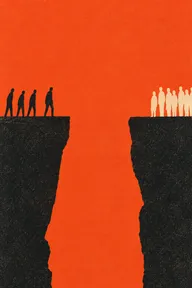
A few impressive customers can make a technology company look ready to scale when its hardest transition has barely begun. Moore calls the gap between visionary early adopters and the pragmatic early majority the chasm. Each group buys for different reasons, so success with one does not automatically persuade the other.
The Technology Adoption Life Cycle moves through innovators and early adopters into the early and late majorities, ending with laggards. This model matters especially for discontinuous innovations: products that require changes in behavior or supporting infrastructure. An electric car, in the book’s 1990s example, demands a different refueling system. A faster conventional car does not.
Visionaries accept disruption to gain a competitive breakthrough. Pragmatists seek predictable improvements that fit existing operations. They want production references from comparable customers, while visionaries are comfortable being first. This creates a circular problem: pragmatists want other pragmatists to buy before they do.
Takeaway
A reference customer helps only when the next buyer recognizes that customer’s priorities and circumstances.
Client-server computing illustrates the delay. Gartner endorsed it in 1987, but Moore dates its emergence as a viable software category to 1992, after Windows provided a standard graphical client. Publicity ran ahead of the supporting infrastructure. Before expanding the sales force, distinguish an early-market burst from repeatable mainstream demand. Moore’s framework comes from consulting experience and business anecdotes; he explicitly acknowledges the absence of documented studies backing his examples.