Sift Get the app
Introduction
Your thinking habits may need more movement
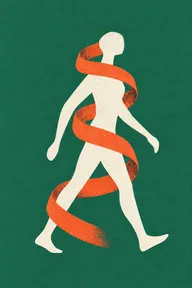
You can exercise every morning and still spend most of your life motionless. Caroline Williams investigates what that pattern does to the mind, and why walking, dancing, or changing your breathing can produce surprisingly different effects.
Why We Move
Thinking evolved alongside the need to move
A young sea squirt swims around using a simple nervous system. Once it attaches permanently to a rock, it digests most of that machinery. Neuroscientist Rodolfo Llinás uses this strange life cycle to illustrate an evolutionary proposition: brains help animals move safely toward rewards and away from danger.
Human thinking developed alongside increasingly demanding movement. Anthropologist Robert Barton proposes that swinging through trees helped expand the cerebellum’s capacity for sequencing actions, circuitry later recruited for complex thinking. David Raichlen and Gene Alexander’s adaptive capacity model links our brain’s responsiveness to exercise with the demands of hunting and gathering. These are evolutionary explanations, rather than direct demonstrations of how every mental skill originated.
The everyday connection runs through proprioception, our sense of bodily position, and interoception, our sense of internal conditions. Antonio Damasio places these bodily updates near the foundation of feeling and selfhood. Movement changes those updates. That gives us a physical route into mental states that we often try to change through thought alone.