Sift Get the app
Introduction
One disease can produce six different diagnoses
Six people with stomach ulcers enter a Chinese medical clinic and leave with different diagnoses. Kaptchuk traces the reasoning behind those distinctions, then confronts the harder questions of evidence and safety.
1. Two ways of seeing
A disease and a pattern describe different things
A biomedical diagnosis can group patients together while Chinese medicine separates them. Kaptchuk illustrates this with six ulcer patients: one has burning symptoms relieved by cold, another feels depleted and seeks warmth, while another experiences attacks associated with anger. Their shared disease becomes several patterns of disharmony.
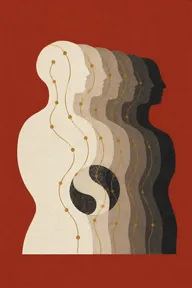
A pattern gathers bodily signs and emotional experience into a configuration that guides treatment. Yin and Yang supply its relational grammar. Neither represents a fixed substance: water can be yielding, hence Yin, and moving, hence Yang. Each quality takes meaning from its comparison and context.
Kaptchuk rejects both dismissing Chinese medicine as superstition and treating it as superior ancient wisdom. He also acknowledges that his East-West contrast simplifies biomedicine, which already contains approaches attentive to the whole person. Understanding a pattern’s internal logic is a different task from establishing whether its treatment works.