Sift Get the app
Introduction
Weightlessness happens where gravity is still working
Astronauts float while Earth’s gravity keeps pulling them around the planet. Nicholas Mee follows this apparent contradiction from falling objects to black holes, where familiar ideas about force and time begin to fail.
Can You Feel the Force?
Your weight is the feeling of being stopped
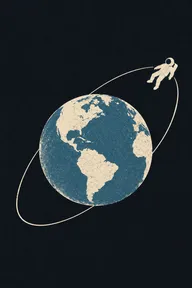
An astronaut in orbit is falling toward Earth continuously. The spacecraft falls alongside its occupants, and every part of their bodies accelerates together. With nothing holding them up, they feel weightless despite being firmly within Earth’s gravitational field.
David Scott demonstrated the underlying principle on the Moon during Apollo 15. He dropped a hammer and a feather together, and both reached the surface simultaneously. Without atmospheric resistance, their different masses made no difference to their acceleration. In Newton’s account, greater mass increases gravitational attraction and resistance to acceleration by exactly compensating amounts.
Standing on Earth feels different because the ground prevents that free fall. Electromagnetic interactions within the floor and your body supply the supporting forces you experience as weight. There is a qualification: gravity varies across extended objects. Near a sufficiently compact mass, differences between the pull on your head and feet produce destructive tidal stretching. Distinguishing support forces from tidal gravity prepares the ground for Einstein’s much stranger account.
Takeaway
Weightlessness means falling without support, even when gravity is strong enough to hold you in orbit.