Sift Get the app
Introduction
Physics works brilliantly until its foundations collide
Einstein’s gravity and quantum mechanics explain astonishing amounts of reality, yet combining them produces mathematical disaster. Michio Kaku follows the search for a single equation, including the uncomfortable gap between string theory’s promise and its evidence.
1. The ancient dream
Unification makes different phenomena obey the same rules
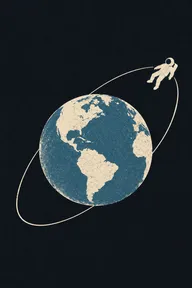
An apple falling and the moon orbiting Earth look like different events. Newton’s breakthrough was to describe both with the same gravitational law. Imagine firing a cannonball from a mountain increasingly fast: eventually, Earth curves away beneath it as quickly as it falls. An orbit becomes continuous free fall, joining terrestrial motion with the heavens.
That shared explanation could make risky predictions. When Uranus strayed from its calculated orbit, Urbain Le Verrier used Newton’s laws to predict an unseen planet. Astronomers found Neptune in 1846 within one degree of the predicted location. The episode establishes a recurring standard for Kaku’s story: an invisible entity can become scientifically credible through measurable consequences.
Takeaway
Indirect evidence can test an unseen object when a theory predicts its measurable effects.
Faraday and Maxwell achieved another unification. Faraday’s experiments connected electricity with magnetism; Maxwell expressed their relationship mathematically and found that changing electric and magnetic fields could sustain a traveling wave. Its calculated speed closely matched light’s. Light itself belonged to electromagnetism, opening the way to radio and electrical technology.
Symmetry runs through these successes. A law has a symmetry when some transformation leaves it unchanged, as rotating a sphere leaves its appearance intact. Kaku treats symmetry as a clue to shared physical structure. Yet by 1900, the apparent completeness of Newton and Maxwell concealed a contradiction: their accounts of motion and light did not fit together.