Sift Get the app
Introduction
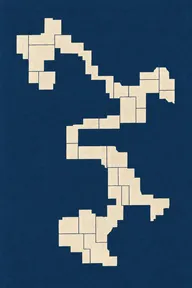
An election can be rigged with ordinary rectangles
A district map can look perfectly reasonable while insulating politicians from voters. Jordan Ellenberg follows the geometry behind that trick into machine learning and pandemic forecasts, revealing how much depends on the shapes we choose.
1. Proof and honesty
Learn what would actually justify your belief
Abraham Lincoln studied Euclid because he wanted to understand what it meant to demonstrate something beyond doubt. Geometry offered a discipline: identify your starting assumptions, then account for every step connecting them to your conclusion.
Ellenberg sees the value of proof in learning to recognize non-proofs. A confident declaration that someone is being logical can conceal disputed premises. The hardest arguments to audit are often our own.
Yet rigor without discovery becomes empty schoolwork. Ben Blum-Smith’s “gradient of confidence” captures what teaching should provide: movement from something obvious toward something surprising. A dissection proof of the Pythagorean theorem gives that experience. The goal is to understand why a claim holds, while remaining willing to question the assumptions supporting it.