Sift Get the app
Introduction
Great art is made in a war against patrons, politics, and the self
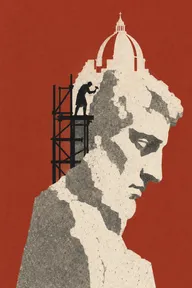
Irving Stone turns Michelangelo into more than a genius in marble. He becomes a worker at war with almost everything around him: his father's hunger for status, the Church's demands, corrupt patrons, rival artists, political chaos, and his own impossible standards.
What makes this novel endure is not just the Renaissance spectacle. It shows the cost of building anything lasting when the world keeps asking for something easier, safer, or more useful. Michelangelo's struggle is not only about art. It is about whether a life can be organized around one uncompromising calling.
The Studio
Talent announces itself before it is welcome
Michelangelo begins as a difficult thirteen-year-old who wants one thing with painful clarity: to draw and eventually to sculpt. His father, Lodovico Buonarroti, sees art as manual labor beneath a noble burgher family. What Michelangelo sees instead is vocation. He bargains his way into Ghirlandaio's workshop by sheer nerve, insisting that the painter pay him because his father will never fund the apprenticeship.
The early scenes matter because they establish the pattern of his whole life. He is not charming, diplomatic, or socially smooth. He is stubborn, exacting, and already willing to endure beatings rather than give up his direction. In Ghirlandaio's studio he learns the mechanics of fresco, cartoons, pigments, and deadlines, but he also learns that painting as practiced in Florence often serves fashion, patrons, and civic decoration more than the inner truth he wants.
Stone makes this conflict concrete through a boy who copies Giotto and Masaccio in churches, steals time to study, and instinctively redraws figures with more anatomy and force than the workshop style allows. Even before he has training, his eye is already pushing against convention.
The practical implication is harsh and useful: raw ability is not enough. A calling usually appears first as friction. If the environment greets your strongest impulse with resistance, that may be the first evidence that it matters.
Takeaway
The first test of vocation is not applause. It is whether you keep moving toward the work when the people closest to you think it is a mistake.