Sift Get the app
Introduction
You are not the point of evolution
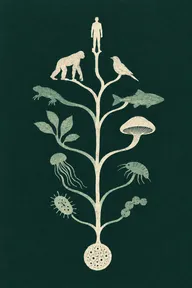
Dawkins and Wong retell the history of life backwards, starting with us and walking step by step toward the first replicator. That reversal changes everything. Instead of seeing evolution as a march toward humans, you watch lineages merge into deeper and deeper kinship until chimpanzees, mushrooms, jellyfish, and bacteria all become family.
The payoff is bigger than a tour of fossils and genes. The book uses that backward pilgrimage to explain what evolution really is: not progress toward us, but branching, convergence, contingency, and deep patterns that repeat because natural selection keeps solving similar problems in similar ways.
The conceit of hindsight
Backwards history fixes the usual mistake
The book begins by attacking the "conceit of hindsight": the habit of telling evolutionary history as if everything were aiming at Homo sapiens. Dawkins is especially sharp about textbook phrases like Homo habilis being "more evolved" than australopithecines, or early fish being "half way" to land animals. A living creature is never an unfinished version of us. It is a fully current solution to its own world.
“Evolution has no privileged line of descent and no designated end.”
The remedy is to do history backwards. Start with a modern species, humans in this case, and move toward older and older common ancestors. That automatically centers unity rather than vanity. Instead of picturing evolution as a ladder, you picture a series of rendezvous points where other living lineages join the pilgrimage.
That frame matters because it changes what counts as a milestone. The crucial events are not steps upward but moments of shared ancestry: chimpanzees join us, then gorillas, then orang utans, then mammals, then vertebrates, then animals, then all life. The implication for the reader is simple and disorienting: every organism alive today is equally modern, and every story of life is partly a story of kinship.