Sift Get the app
Introduction
A road trip turns into a political awakening
The Motorcycle Diaries is not the legend of Che Guevara in hindsight. It is the rough, funny, often hungry account of a 23 year old medical student crossing South America with his friend Alberto Granado, breaking down on roads, sleeping in police stations, stowing away on ships, and talking to miners, workers, Indigenous families, and leprosy patients.
What makes the book matter is the shift happening inside the traveler. Ernesto begins chasing adventure. He ends with a new way of seeing Latin America: not as a collection of countries, but as a shared reality marked by exploitation, dignity, and unfinished struggle. The ride on La Poderosa II becomes the making of a political consciousness.
Setting out
Adventure comes first, not ideology
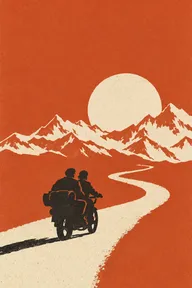
Ernesto begins with a warning: this is not a tale of heroic feats. He presents the journey as the record of two young men with converging dreams, setting off almost impulsively from Argentina in late 1951 on Alberto Granado's battered Norton 500, La Poderosa II. Their first motives are loose, romantic, and recognizably young: escape, movement, curiosity, women, road dust, and the thrill of seeing the continent.
“All this wandering around Our America with a capital A has changed me more than I thought.”
That tone matters because the book does not start with a finished revolutionary. It starts with a medical student still tied to private concerns, including a girlfriend in Miramar and fantasies of future adventure. The early pages are full of comic mishaps, vanity, makeshift repairs with wire, and a narrator who is perfectly willing to mock himself.
The practical insight is simple and human: worldviews do not usually change all at once. They get loosened first. Ernesto leaves home thinking like a restless individual looking for experience. The road begins by stripping away comfort, routine, and self-importance.