Sift Get the app
Introduction
A life can be changed by crossing a desert and taking another civilization seriously
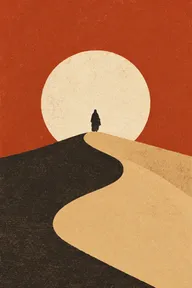
Muhammad Asad's memoir is not a travel diary in the usual sense. It is the story of a European intellectual who enters the Arab and Muslim world as a reporter, finds that its moral and spiritual vocabulary answers questions the West has stopped asking, and ends up giving his life to Islam.
What makes the book endure is that it is doing three things at once: adventure narrative, political witness, and philosophical conversion story. Asad is trying to understand why modern Western life feels spiritually unmoored, why the Muslim world had declined from its own heights, and what it would mean to live as if spirit and daily life belonged together.
The story of a story
He writes to explain a crossing that looked impossible from the outside
Asad opens by explaining why this book exists at all. By the early 1950s he was serving as Pakistan's representative at the United Nations, and Western acquaintances could not understand how a man born and educated in Europe could identify fully with the political and cultural aims of the Muslim world. Their questions forced him to tell the story of how Leopold Weiss became Muhammad Asad.
He insists the book is not mainly an adventure memoir, though it contains plenty of danger. The real drama is inward. His life had taken him from journalism in Europe to conversion in 1926, years of friendship with Ibn Saud, work with Muhammad Iqbal in India, and eventually a role in the making of Pakistan. That arc made him a rare interpreter between worlds.
He also offers one of the book's boldest claims: much of the West's prejudice against Islam goes back to the Crusades. In his telling, Europe learned to define itself against a caricature of Islam as sensual, violent, and spiritually inferior. This matters because his memoir is meant not just as a personal history, but as an argument for seeing Islamic civilization without inherited distortion.
Takeaway
The memoir is Asad's answer to a Western question: how could a European cross over so completely?