Sift Get the app
Introduction
Civilization may have started with a song, not a wall
Bruce Chatwin goes to Australia chasing a strange idea: that Aboriginal Songlines are not just myths or maps, but clues to what human beings are for. The result is part travel narrative, part anthropology, part philosophical provocation about movement, memory, territory, and why settled life may make us miserable.
What makes The Songlines last is not that it solves the mystery. It is that Chatwin keeps widening the question. Song becomes map. Walking becomes law. Myth becomes land tenure. And a trip through Central Australia turns into an argument that human beings may be a migratory species trying, badly, to live as if we were not.
Alice Springs
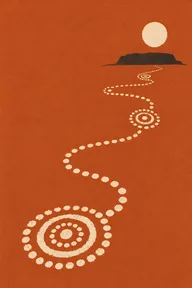
A Songline is a map you sing into existence
Chatwin’s guide into the book is Arkady Volchok, a Russian-Australian who works with Aboriginal communities around Alice Springs. Arkady introduces the central idea with startling simplicity: in Aboriginal cosmology, ancestral beings wandered across the continent in the Dreamtime, singing the names of birds, animals, rocks, waterholes, and plants. By naming them, they brought them into being.
That is why a Songline is more than folklore. It is route-map, title deed, memory system, and sacred law at once. If you know the song, Arkady says, you can cross country. Every verse corresponds to a stretch of land, every landmark to an event in the Ancestor’s journey. Song is both geography and guidance.
The practical stakes are not abstract. Arkady is helping survey sacred sites along a proposed Alice to Darwin railway. The problem is that to a surveyor, sacredness should attach to a rock, a waterhole, a tree. To the old men he works with, the whole country is sung. A featureless stretch of gravel can matter as much as a cathedral if it holds a section of the Ancestor’s track.
Takeaway
In Chatwin’s Australia, land is not owned because it is fenced. It is owned because it is remembered, sung, and ritually maintained.