Sift Get the app
Introduction
Racism lives in the body, not just in beliefs
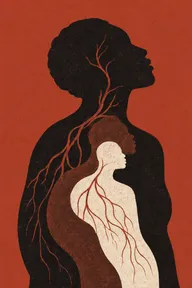
Resmaa Menakem's central move is blunt: white supremacy is not mainly an idea problem. It is a body problem. It lives in muscle tension, startle responses, inherited fear, and the nervous system's reflex to fight, flee, or freeze. If you only argue with people’s opinions, you miss where the pattern is actually stored.
That shift changes everything. Instead of asking only what people think about race, Menakem asks what their bodies do around race. Why does a white body tense near a Black body? Why does a Black body brace around police? Why do police bodies so often jump from stress to force? His answer is trauma, passed person to person and generation to generation.
The body first
Trauma is the body’s survival response
Menakem defines trauma in a way that is more physical than psychological. Trauma is not the event itself. It is the body’s protective response to something that felt like too much, too fast, or too soon. Once that response gets stuck, the body keeps telling a wordless story about danger, even when the original threat is gone.
That is why he starts with the vagus nerve, which he renames the soul nerve, and with the lizard brain that only knows rest, fight, flee, or freeze. In racial situations, people often act before thought arrives. The body constricts, adrenaline surges, and reasoning gets overridden. Menakem’s point is not that ideas do not matter. It is that the nervous system gets there first.
He makes this personal through his grandmother, whose thick hands came from sharecropping and cotton picking at age four. Her body carried history in a literal way. That is the book’s lens: history is not just remembered in stories or laws. It is carried in flesh.
Takeaway
If racism is lodged in the nervous system, healing has to involve the nervous system too.